News

Learn about our news, technologies and projects

Técnicas Reunidas is participating in a new European research project under the Horizon Europe program to develop green technology for the production of hydrogen peroxide

As part of the Horizon Europe program, the European Commission approved the launch of a new research project, POWER2HYPE, in 2023 – Electrochemical Synthesis of Hydrogen Peroxide from Water, Air, and Renewable Energy, focused on developing new green technologies for hydrogen peroxide production. The European Commission’s Horizon Europe program aims to promote research, development, and innovation projects led by companies or research centers to provide technological solutions to today’s major European challenges.

Hydrogen peroxide (H₂O₂), commonly known as hydrogen peroxide, is a chemical used in everyday life. Furthermore, ranked among the 100 most important chemicals worldwide, its industrial applications include wastewater treatment, bleaching, sanitation, chemical synthesis, and use as an aerospace fuel. Europe produces around 35% of global hydrogen peroxide (1.2 million tons), and it is estimated that this production will grow exponentially through 2030.

Currently, industrial production of hydrogen peroxide is based predominantly on the auto-oxidation process of alkylanthraquinone. This process, which is highly energy-intensive and relies primarily on fossil fuels, results in estimated greenhouse gas emissions accounting for 1.8% of the total emissions from the chemical industry in Europe. At the same time, the characteristics and costs of this process limit it to centralized production in large chemical plants, restricting supply to remote areas and also generating a high volume of toxic waste.

The goal of the POWER2HYPE project is precisely to research, develop, and demonstrate a new process for producing hydrogen peroxide, replacing the current energy-intensive route with a sustainable electrochemical one. The process relies on the use of accessible and sustainable materials for the fabrication of both the structural and catalytic components of the reactor. Furthermore, it uses only water and air as reactants, and the electrolytes employed are aqueous. The process emits no toxic waste or greenhouse gases thanks to its characteristics and the possibility of powering it with renewable energy. Compared to the established process, the new electrochemical route proposed by POWER2HYPE aims to achieve greater overall energy efficiency in hydrogen peroxide production in a sustainable, decarbonized, and emission-free manner, while also enabling both industrial and decentralized production, making it potentially profitable even in miniaturized lines.

The project, led by the German technology center Fraunhofer Institute and involving Técnicas Reunidas, also includes companies from the Solvay group (Solvay S.A., Rhodia Operations, Rhodia Laboratoire du Futur, and Solvay Specialty Polymers), SMEs such as DiaCCon, SGL Carbon, SolvGE, GLOBAZ, and IRIS Technology Solutions, as well as prestigious universities and R&D&I centers such as Wageningen University and Research Center for Food and Bio-based Innovation, the University of Erlangen-Nuremberg, and the University of Linz.

Técnicas Reunidas plays a prominent role as a developer of innovative cell and stack configurations, as well as in the final process integration, the design and implementation of a facility for the characterization of a 2.5 kW power stack and its pilot-scale evaluation for a peroxide production capacity of 20 kg/day.

With a strong focus on decarbonization and the energy transition of European industry, the project aligns with the pillars of the European Commission’s REPowerEU initiative for the rapid reduction of fossil fuel and raw material use in industry and energy. Consequently, POWER2HYPE will contribute to the fight against climate change through the reduction of emissions and the carbon footprint, driven by the United Nations Sustainable Development Goals (SDGs) and the European Union’s Green Deal.

POWER2HYPE has a budget of 10 million euros, fully funded by the European Commission, for a total duration of 4 years.

POWER2HYPE Website

Técnicas Reunidas is participating in a research project to develop solid oxide electrolysis (SOE) technology for the production of green hydrogen

  • The efiSOEC project is researching new green hydrogen production technologies to contribute to the decarbonization of the Spanish economy.
  • The project consortium, in which TÉCNICAS REUNIDAS S.A. is collaborating, is led by REPSOL and includes three other Spanish companies: TUBACEX S.A., EPOWERLABS S.L., and ZGR CORPORACIÓN S.A.
  • efiSOEC benefits from the contribution of five research organizations: INSTITUT DE RECERCA EN ENERGIA DE CATALUNYA (IREC), CENTRO NACIONAL DEL HIDRÓGENO (CNH2), DYPAM-UNIVERSITY OF CASTILLA-LA MANCHA, TECNALIA RESEARCH & INNOVATION, and CIDETEC.
  • The project was included in the Missions Program of the Center for Industrial Technological Development (CDTI), having received the second-highest rating in the 2022 edition of the program.


Context

Climate change is having a growing impact on our planet, and mitigating it is an increasingly urgent challenge. To this end, it is necessary to decouple from fossil-based raw materials and fuels to enable the gradual decarbonization of all sectors of the economy, thereby achieving the European Commission’s 2050 carbon neutrality targets.

In this context, the project led by Repsol entitled “Research and analysis for the development of proprietary SOEC technology for the generation of efficient hydrogen production systems,” with the acronym efiSOEC, was launched.  

Técnicas Reunidas, as a leading engineering firm in international energy transition projects, is participating in the business group developing the efiSOEC R&D project, whose main objective is to research, analyze, and generate knowledge about a new system for producing green hydrogen with high efficiency and durability, based on high-temperature solid oxide electrolysis cells (SOEC).

This project will be carried out by a consortium comprising five Spanish companies: REPSOL S.A., TÉCNICAS REUNIDAS S.A., TUBACEX S.A., EPOWERLABS S.L., and ZGR CORPORACIÓN S.A.

In addition, the project benefits from the contribution of seven research organizations: INSTITUT DE RECERCA EN ENERGIA DE CATALUNYA (IREC), CENTRO NACIONAL DEL HIDRÓGENO (CNH2), DYPAM-UNIVERSITY OF CASTILLA-LA MANCHA, TECNALIA RESEARCH & INNOVATION, and CIDETEC.


Project

The collaborative business R&D project titled “Research and analysis for the development of proprietary SOEC technology for the generation of efficient hydrogen production systems” and with the acronym “efiSOEC,” has been funded by the Center for Technological Development and Innovation (CDTI) and supported by the Ministry of Science and Innovation as part of the 2022 call for proposals under the Science and Innovation Missions program.

It is worth noting that this project, part of the Missions Program, received the second-highest score of all projects submitted in the program’s 2022 call for proposals.

efiSOEC aims to address the challenges posed by the decarbonization of energy-intensive industries through the development of domestic solid oxide electrolysis (SOE) technology for the efficient production of renewable hydrogen and the creation of the industrial infrastructure necessary for its commercialization. SOEC technology stands out for enabling the production of green hydrogen from renewable energy sources with efficiencies superior to those of low-temperature electrolysis, making it highly suitable for industrial application.

In this project, which began in 2022, the performance of different materials, structures, and configurations of SOEC cells is being analyzed with the aim of developing more efficient and resilient stacks, with power ratings of 3 kW, that overcome the current limitations of the technology. The most industrially viable solutions will be scaled up and integrated into a 24 kW modular system which, following an analysis and implementation of the necessary auxiliary systems, will be characterized and validated according to previously identified industrial performance indicators. In parallel, based on the results and solutions obtained, those that enable the scaling and industrialization of the system will be evaluated and identified, thereby facilitating rapid future implementation in Spanish industry.

Specifically, the contribution of each of the companies participating in this project is as follows:


Repsol:

Will coordinate the technical activities to be carried out to achieve the main objective; will develop the 3 kW and 24 kW efficient systems; will evaluate the validation of these systems; will study the challenges of scaling and industrialization based on the results obtained.


Técnicas Reunidas:

Will develop the 3 kW and 24 kW efficient systems; will design and plan the strategy for the test bench validation plan; will evaluate the validation of these systems; will study the scaling challenges based on the previous results through intermediate pre-conceptual designs of 100–250 kW.


Tubacex:

Will design, produce, characterize, and validate SOEC stacks with alternative geometries at the laboratory scale.


Epowerlabs:

Will design and develop the DC power electronics suitable for the newly developed SOEC module; will develop proprietary high-complexity software to make the EFISOEC module efficient, stable, and durable.


ZGR:

Will develop an AC/DC power electronics converter suitable for the new SOEC system; will study the integration of the new converter with renewable energy sources, as well as its bidirectional capability and adaptability.

Técnicas Reunidas is participating in a new European research project under the Horizon Europe program focused on new flexible and sustainable electronic components.

Under the Horizon Europe program, the European Commission has approved the launch of a new research project, ECOTRON—Minimizing the Environmental Footprint of Printed Electronics, focused on developing new technologies for organic and flexible printed electronic substrates.

The European Commission’s Horizon Europe program aims to promote research, development, and innovation projects led by companies or research centers to provide technological solutions to today’s major European challenges

The project, called ECOTRON, is led by the Dutch technology center TNO and, with the participation of Técnicas Reunidas, also includes companies of European significance such as Janssen Pharmaceuticals, Polar, Signify, and Beckton Dickinson, as well as prestigious R&D&I centers such as ITENE, VTT, CEA, and the Polytechnic University of Milan.

The project, which aims to increase the environmental sustainability of current electronic devices through new materials and manufacturing and recycling processes for flexible organic substrates, aligns with the objectives of the Circular Economy and the concept of Safe and Sustainable by Design, promoted by European policies.

In recent years, the need for continuous data collection, real-time information, and greater connectivity has resulted in an exponential increase in electronic functionalities integrated into nearly all devices used in our daily lives. These functionalities include, among their main components, printed circuit boards (PCBs), which provide both mechanical support and electrical connectivity between the various components through an electronic circuit. The most commonly used PCBs consist of non-recyclable rigid epoxy fiber (FR4) substrates. The circuit is manufactured by chemically etching a superimposed copper layer, to which electronic components—such as chips and microsensors—are added via a high-temperature soldering process. Despite the widespread use of electronic devices, the dismantling and recycling of PCBs is still a very limited practice and is usually restricted to the recovery of certain metals. In contrast, the lifespan of electronic devices continues to shrink, with the resulting environmental impact due to the lack of management and accumulation of the waste generated. To mitigate this problem, the development of flexible organic printed electronics (FOPEs) emerges as one of the most promising alternatives to PCBs for achieving sustainable electronics through low-energy, chemical-free additive manufacturing processes using organic and recyclable materials.

The goal of the ECOTRON project is to drive the development of these new substrates in a holistic manner, including not only advancements and improvements in the materials that compose them, but also the integration of circular processes for their manufacturing and recycling, and the study of eco-design to facilitate these processes. With their final validation as components in everyday electronic devices, medical devices, wearables, and smart packaging, ECOTRON will contribute to the goal of advancing toward consumer electronics with innovative functionalities that are, at the same time, more sustainable.

The project is fully integrated into circular economy strategies, as its development will enable the reuse of all components from end-of-life devices through eco-design focused on recovery and greater efficiency in recycling processes, thereby reducing the use of natural resources, pollution, and waste, as well as CO2 emissions. In short, it will contribute to the fight against climate change by reducing emissions and the carbon footprint, in line with the United Nations Sustainable Development Goals (SDGs) and the European Union’s Green Deal.

Técnicas Reunidas will play a prominent role as a developer of new sustainable methodologies for the extraction of critical metals and the recycling of plastics, as well as in the integration of processes for the design of a future circular manufacturing plant, as well as an industrial partner in making the project’s advancements available to society.

The project will have a budget of 5 million euros, fully funded by the European Commission, for a total duration of 4 years.

 

ECOTRON Website

Técnicas Reunidas will lead a research project on plastic recycling as part of the CDTI’s Misiones program.

  • The project, called ECLIPSE and clearly aligned with the goals of the circular economy, will help make it possible to utilize secondary raw materials derived from the recycling of complex polymeric waste, thereby reducing the use of natural resources and pollution caused by landfills.
  • The Science and Innovation Missions program, overseen by the Center for Industrial Technological Development (CDTI), is part of the State R&D&I Plan approved in 2021 and aims to promote projects led by companies conducting relevant research to find solutions to the main cross-cutting and strategic challenges facing Spanish society.
  • A total of 111 projects were submitted to this second call for proposals under the program, of which 37 were approved. The project led by Técnicas Reunidas was the third highest-rated in the call.
  • The consortium that will carry out the research also includes seven other companies covering the entire plastic recycling value chain (ACTECO, PICVISA, REPSOL, CELLMAT TECHNOLOGIES, GRUPO COPO, SYNTHESIA, and SEAT), and the project office will be coordinated by CETIM Technology Center.


Madrid, January 18, 2022.—The Center for Industrial Technological Development (CDTI) has approved the inclusion of a research project focused on plastics recycling and led by Técnicas Reunidas in the second call for proposals of its Science and Innovation Missions program.

The project, named ECLIPSE and titled “Research into New Technologies for the Recycling and Recovery of Complex Plastic Waste,” was the third highest-rated in the call.

A total of 111 projects were submitted to this call, of which 24 proposed by large and medium-sized companies and 13 by SMEs were approved.

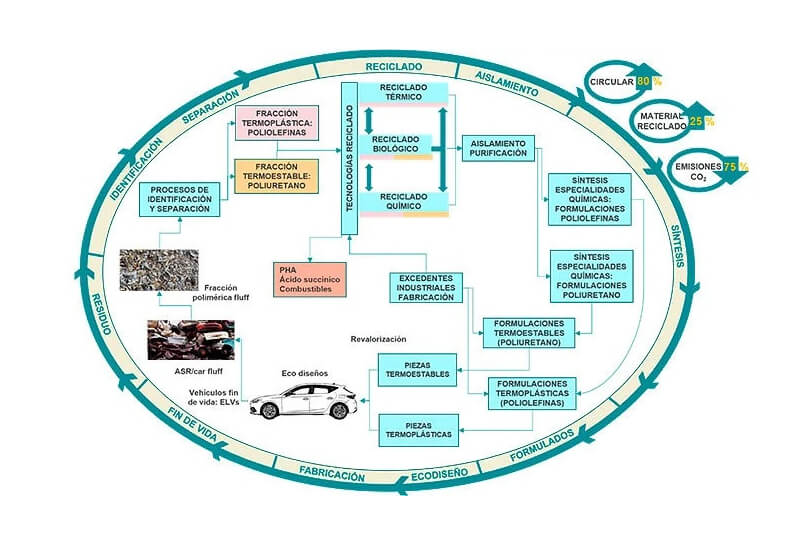
The objective of the ECLIPSE project is to investigate new technological pathways that facilitate the recycling and recovery of complex polymeric waste (plastics) and that represent a significant advance over the current state of the art in terms of separation, recycling, purification, and chemical synthesis to obtain new polymers suitable for reuse. In short, its goal is to develop a sustainable, circular, and comprehensive system for the recycling and revalorization of complex plastic waste—one that is versatile, tested in the automotive sector, and transferable to all strategic industrial sectors

This objective is particularly relevant today, as mechanical recycling of plastics—the most established technology due to its economic viability and simplicity—presents significant limitations for the recycling of complex plastics. Consequently, the ECLIPSE project could represent a significant step forward in addressing the environmental problems caused by plastic waste.

The project is fully integrated into circular economy strategies, as its development will enable the use of secondary raw materials derived from the recycling of complex polymeric waste, thereby reducing the use of natural resources, pollution, and landfills, and facilitating greater efficiency in recycling processes. Ultimately, it will contribute to the fight against climate change by reducing emissions and the carbon footprint, in line with the United Nations Sustainable Development Goals (SDGs) and the European Union’s Green Deal.

A project developed by a strong business consortium

The project will focus on research into the separation and identification of complex polymeric waste; combined thermal, chemical, and biotechnological recycling technologies; processes for the isolation and purification of chemical compounds of high industrial interest; the synthesis of specialty chemicals; polymer formulations; and eco-designs for products.

These tasks will be carried out by a consortium comprising eight companies—ACTECO PRODUCTOS Y SERVICIOS, CELLMAT TECHNOLOGIES, GRUPO COPO, PICVISA MACHINE VISION SYSTEMS, REPSOL, SEAT, SYNTHESIA TECHNOLOGY EUROPE, and TÉCNICAS REUNIDAS—led by the latter.

These eight companies, which possess proven expertise in various technological fields, will be responsible for the planned work according to the following distribution: industrial research on the composition and origin of automotive waste (SEAT) and industrial waste (GRUPO COPO); identification and separation of complex plastic waste streams (PICVISA and ACTECO); alternative recycling methodologies with substantial improvements based on thermal (TÉCNICAS REUNIDAS), biotechnological (REPSOL), and chemical (SYNTHESIA, ACTECO, and CELLMAT TECHNOLOGIES) treatments; purification and isolation stages for chemical units of interest (TÉCNICAS REUNIDAS); synthesis of thermoplastic and thermosetting specialty chemicals (SYNTHESIA and CELLMAT TECHNOLOGIES); polymer formulations (CELLMAT TECHNOLOGIES and GRUPO COPO), and eco-design and manufacturing of products (GRUPO COPO and SEAT). 

CETIM is responsible for coordinating the project office and will also carry out, among other tasks, the analysis of complex plastic waste, support for partners in the eco-design of recycling technology pathways, collaboration in research on various thermal, chemical, and biological technologies, and the analysis of the final product proposals. 

ECLIPSE also benefits from the cooperation of seven other research organizations: the Polytechnic University of Valencia (UPV), the University of Zaragoza (UNIZAR), the LEITAT Technology Center, the University of Valladolid (UVA), the Sarriá Chemical Institute (IQS), the Galician Automotive Technology Center (CTAG), and the National Supercomputing Center (BSC).

The project, which will run for 38 months, will have a budget of 7.3 million euros, with a grant of 4.4 million, equivalent to 59% of the budget.

The Science and Innovation Missions Program

The CDTI’s Science and Innovation Missions program is part of the State R&D&I Plan approved in 2021 and aims to promote projects led by companies that conduct relevant research capable of finding solutions to the main cross-cutting and strategic challenges facing Spanish society, improving the knowledge and technology base that Spanish companies rely on to compete, and stimulating public-private cooperation.

The program is fully aligned with the Spain 2050 initiative developed by the Spanish government, which outlines the necessary proposals to address the major challenges and problems Spain will face over the next 30 years. 

The missions selected in this second call for proposals focus on key aspects of two of the nine challenges outlined in the Spain 2050 initiative, notably “Becoming more productive to grow better” and “Becoming a carbon-neutral, sustainable, and climate-resilient society.”

The ECLIPSE project has been funded by the Center for Industrial Technological Development (CDTI) under the 2021 call for proposals of the SCIENCE AND INNOVATION MISSIONS Program (Recovery, Transformation, and Resilience Plan), and is supported by the Ministry of Science and Innovation. The grant awarded to the project is funded by the European Union through the Next Generation EU Fund.

RECUMAN PROJECT: Recovery of Manganese Using Hydrometallurgical Processes

The mining and metallurgical sector is compelled to develop increasingly efficient and sustainable production processes that maximize the recovery of metals contained in the ore, including those traditionally considered impurities. This trend is generating new opportunities for the development of hydrometallurgical processes with high market potential. The treatment of unconventional zinc ores with high impurity content that is incompatible with traditional processing is an example of these new market niches.

In the case of metallic zinc, the most widely adopted technology for its extraction is Roasting, Leaching, and Electrowinning (RLE), which is specialized for high-capacity plants (100k–200k tons/year), but with process characteristics that are not suitable for tolerating significant amounts of impurities. This limitation leaves zinc ore reserves with high impurity levels unexploited. One of the most common issues in zinc ores is the presence of manganese, which cannot be removed by the RLE process once its concentration in the ore falls below a very low threshold.

To address this issue, the RECUMAN project, funded by the Center for Industrial Technological Development (CDTI) and spanning two years, aims to develop a flexible technology for recovering manganese from zinc ore in the form of a chemical compound with high market value. The technology’s features will be geared toward efficient processes for extracting manganese at low concentrations in the ore—a challenge that current technology cannot address. 

DUST PROJECT: Development of a Sustainable Process for the Treatment of Steel Mill Dust

Steel dust is a waste product generated in electric arc furnaces in the steel industry during steel production. It is classified as hazardous industrial waste because it contains heavy metals (lead, chromium, cadmium, zinc, etc.), with zinc being the main component. In 2020, more than 10 million tons of steel dust were produced worldwide, representing a zinc content of over 1.7 million tons with a potential market value of more than 3 billion euros annually. Currently, only 50% of the steel mill dust produced globally is recycled and recovered. Specifically, this amount is limited to very large batches due to the high cost of current recycling processes. The remainder, consisting mainly of small-scale batches, is simply subjected to stabilization processes and stored in hazardous waste facilities.

The DUST R&D Project, awarded to Técnicas Reunidas, funded by the Center for Industrial Technological Development (CDTI), and with a duration of 2.5 years, aims to transform steel mill dust waste into new raw materials by developing a flexible and compact technology geared toward small-scale applications—where there is a clear unmet market need not addressed by available technologies—with the primary objective of recovering the zinc present in the waste. To achieve this technology, efforts will focus on developing a process that includes process intensification methodologies, such as new sonication and microwave techniques, along with hydrometallurgical techniques for the leaching of steel dust.

EU Proposal 869703. Development of radical innovations for the recovery of minerals and metals from the brine produced by desalination plants. The goal of the SEA4VALUE project is to lay the groundwork for converting brine produced at desalination plants into a complementary source of critical raw materials. This project brings together 15 partners from industry, universities, and research centers across 7 European countries with the shared goal of developing innovative technologies. Within this consortium, TR plays a key role in developing new selective adsorbents and innovative extraction processes that enable the recovery of valuable metals such as molybdenum, indium, and vanadium.

BIORECOVER (GA No. 821096): Development of a sustainable strategy for the selective biorecovery of critical raw materials from primary and secondary sources. The objective of BIORECOVER is the research and development of a new sustainable and safe process, primarily based on biotechnology, for the selective extraction of critical raw materials from currently unexploited primary and secondary sources of Rare Earths, Magnesium, and Platinum. A consortium of 14 partners from 7 European countries and South Africa, covering the entire value chain, is already working to achieve this goal. TR plays a key role in developing a new, cost-effective, and environmentally efficient purification process to recover rare earth elements and platinum.

Building a sustainable future driven by technology.

Together, we create projects that contribute to sustainability and environmental protection. For more information, please contact us.